Tree cabling and bracing in San Antonio installs steel or synthetic supports in healthy trees with weak forks, splits, or heavy limbs, lowering the risk that those parts fail in wind or ice so a valuable tree can stay.
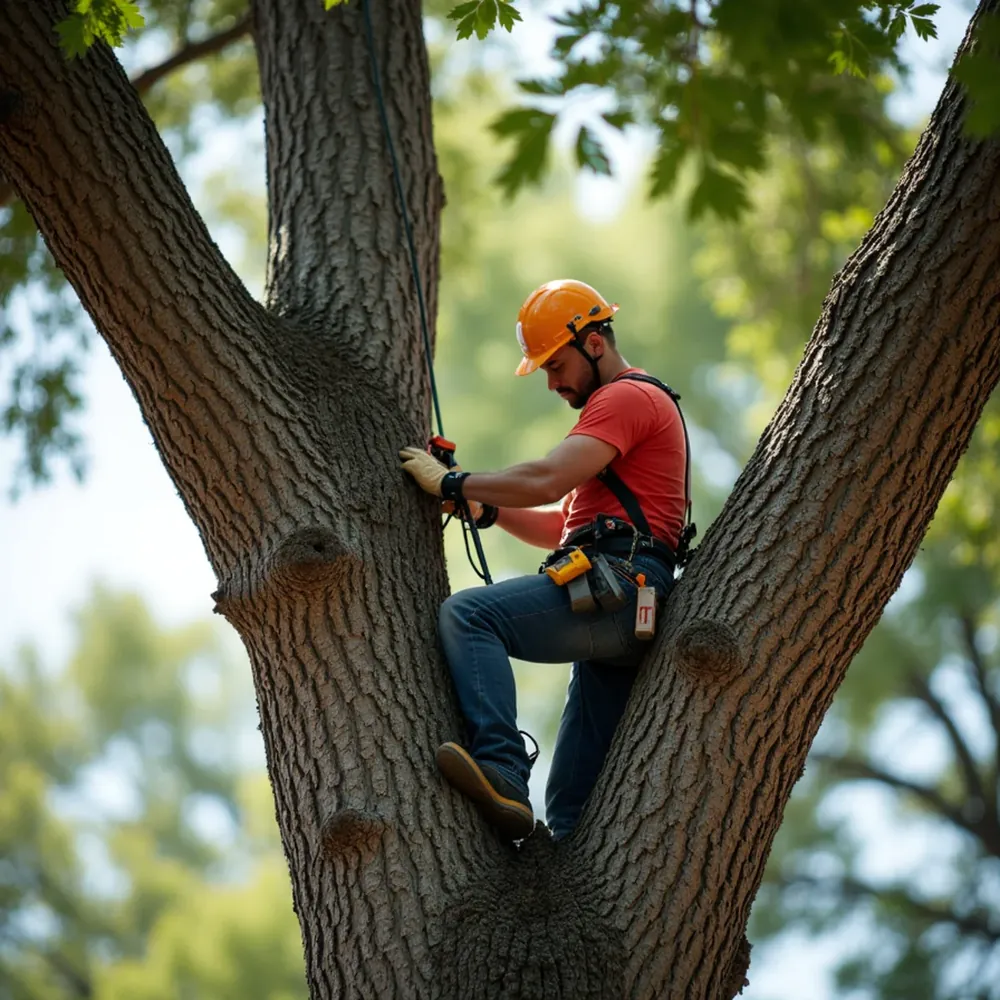
A live oak with two big trunks pulling apart at the fork, a pecan with a limb that's grown long and heavy over the driveway, a cedar elm that cracked in the last ice storm but is otherwise healthy — these are trees worth keeping that need help holding together. Cabling and bracing installs hardware that limits how far the weak parts of a tree can move, which lowers the chance they fail in wind or under ice.
It's not a cure, and it's not right for every tree. We inspect the defect first, tell you honestly whether support will make the tree reasonably safe, and only then quote a system. When a tree is too far gone, we say so — cabling a tree that should come down only delays a bigger problem.
Tree Cabling & Bracing is a specialty part of our tree health care service in San Antonio — same crew, same written estimates, same cleanup standard.
Signs You Need Tree Cabling & Bracing
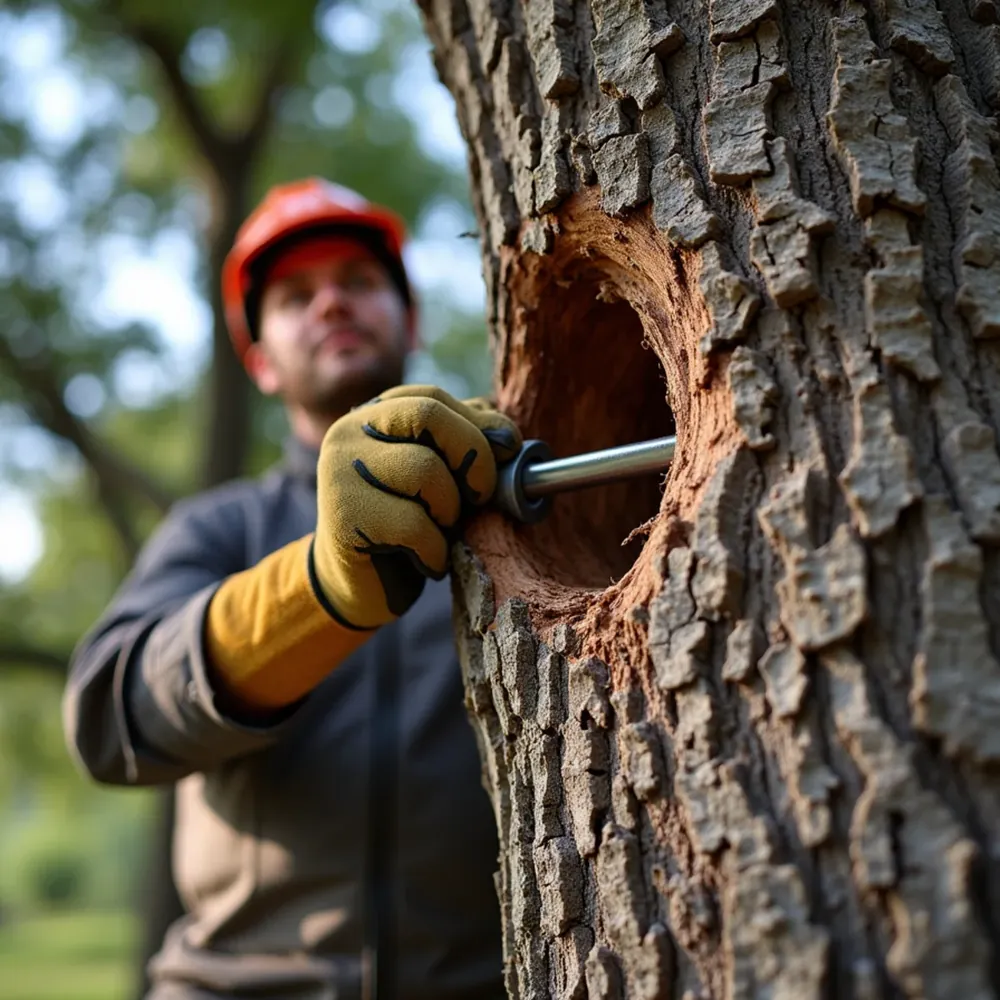
Splitting fork
A crack forming where two trunks or large limbs meet.
V-shaped unions
Narrow forks with bark pinched between the stems.
Long, heavy limbs
Horizontal limbs over a roof, drive, or play area.
Storm-cracked but healthy
A sound tree with damage that can be supported rather than removed.
What Our Tree Cabling & Bracing Includes
Every tree cabling & bracing job in San Antonio is scoped in writing, so you know exactly what you're getting. Here's what's covered:
Defect assessment
Inspection of the fork, crack, or limb attachment, with an honest call on whether support is worth it.
Load-reduction pruning
Selective cuts that take weight off the limbs before any hardware goes in.
Cable installation
Steel or dynamic synthetic cables placed high in the canopy between weak stems.
Bracing rods
Threaded rods through splits and weak unions, sized to the wood.
Oak-wilt wound care
Every oak wound painted immediately, with installs scheduled around the risk window.
Installation record
A written note of hardware type and location for future inspections.
Cabling vs. Bracing: What Each Does
The two terms get used together, but they solve different problems:
- Cabling: A flexible steel or synthetic cable installed high in the canopy — typically about two-thirds of the way up between two limbs or trunks — that limits how far they can spread apart in strong wind.
- Bracing: Threaded steel rods installed through a weak fork or a split, lower in the tree, to hold the wood together and resist twisting.
- Guying: A support anchored to the ground or a structure, used mainly to steady a young or recently disturbed tree.
- Propping: A rigid support under a long, low limb — most often seen under wide-spreading heritage live oaks.
Which San Antonio Trees Benefit
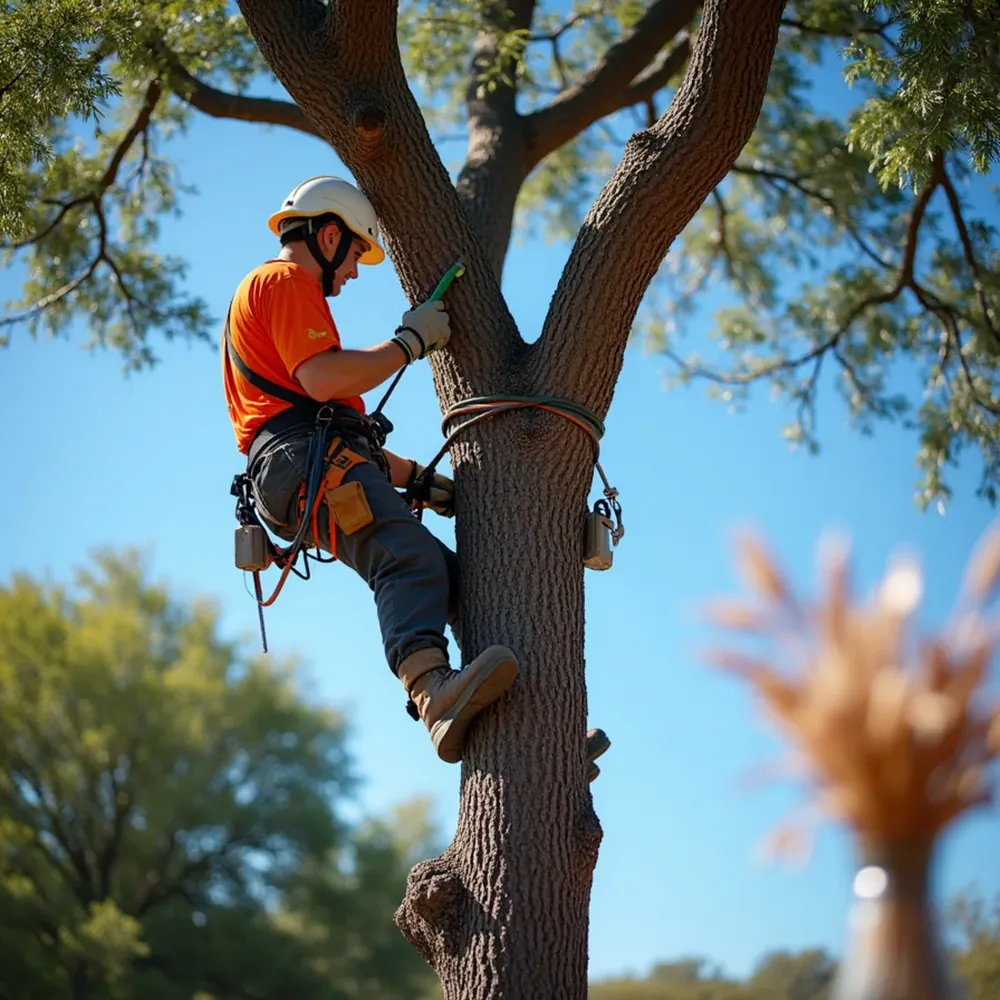
The best candidates are healthy, valuable trees with a specific, fixable weakness. Around San Antonio that usually means live oaks with co-dominant stems: two trunks of similar size growing from a narrow V-shaped fork, with bark trapped between them. Those unions are weaker than a U-shaped fork and tend to split under storm loads.
Pecans and cedar elms are the other regulars. Pecans grow long, heavy horizontal limbs, and cedar elms are known around town for dropping limbs in storms. A cable can take load off a weak attachment without cutting away the shade you're trying to keep.
Cabling is usually the wrong answer for a tree with advanced trunk decay, root rot, active oak wilt, or a crack that runs down into the root flare. Supporting the top of the tree doesn't fix the part that's failing.
How We Install a Support System
Every installation starts with pruning. Reducing end-weight on the limbs being cabled lowers the load the hardware has to carry, and it's often the single most effective step. We follow the ANSI A300 standard for supplemental support systems, which covers hardware sizing, placement, and installation methods.
Steel systems use high-strength cable attached with through-bolts or lag hardware placed so the tree can grow around it. Synthetic systems use dynamic rope-style cables that wrap the limbs without drilling and allow more natural movement. Steel is longer-lived and handles the heaviest loads; synthetic is gentler on the tree and easier to adjust. We recommend whichever suits the tree and the defect.
Bracing rods go in where the defect is — through a split or a weak fork — and are sized to the diameter of the wood. Drilling does make a wound, but a small, clean hole that the tree can wall off is far less harmful than a split that tears open.
Oak Wilt and Installation Timing
Installing hardware in a live oak or red oak means making wounds, and in Central Texas that runs into oak-wilt season. We schedule non-emergency oak installations outside the February 1–July 1 high-risk window and paint every wound immediately, whatever the date. If a split oak needs support during spring, we'll walk you through the trade-off between waiting and acting now.
Inspections Keep a System Working
A support system isn't install-and-forget. Trees keep growing, synthetic cables wear, and steel hardware can be outgrown or loosened. We recommend an inspection every year or two and after any major wind or ice event, and we record what was installed and where so the next inspection has a baseline.
Our Tree Cabling & Bracing Process
- 1
Defect inspection
We assess the union, wood condition, and overall health to decide whether support makes sense.
- 2
Weight-reduction pruning
End-weight comes off first so the system carries less load.
- 3
Hardware installation
Steel or synthetic cables and rods installed and sized to ANSI A300 guidance.
- 4
Documentation & follow-up
We record what was installed and set a schedule for periodic inspections.
Keep a Valuable Tree Standing — Free Structural Check
We'll look at the fork, crack, or heavy limb and tell you honestly whether support will make the tree reasonably safe before you pay for a system.
- Honest save-or-remove call
- Steel or synthetic, per ANSI A300
- Installation record for future inspections
What Affects the Price
We don't post one-size-fits-all prices, because no two trees are the same. Every job is quoted in writing after we see it. These are the factors that move the number up or down:
- Number of cables or rods the tree needs
- Steel versus synthetic system
- Tree height and climbing access
- Pruning required before installation
- Oak-wilt timing and wound treatment
- Follow-up inspection plan
Why San Antonio Chooses Us for Tree Cabling & Bracing
Support only when it works
If a tree needs removal rather than hardware, we tell you before you pay for a system.
ANSI A300 installation
Hardware placement and sizing follow the industry standard for supplemental support.
Pruning and cabling together
One crew reduces the load and installs the support in the same visit.
Inspection plan included
We set expectations for follow-up checks so the system keeps doing its job.
Tree Cabling & Bracing Across San Antonio & Beyond
We install support systems on prized shade trees across Bexar County — big live oaks in Alamo Heights, Terrell Hills, and Olmos Park, pecans along the creeks, and storm-cracked cedar elms in Leon Valley and Windcrest — as well as heritage oaks on Hill Country properties in Boerne and Helotes.
Don't see your area? We serve 68 communities across Bexar County and the Hill Country.