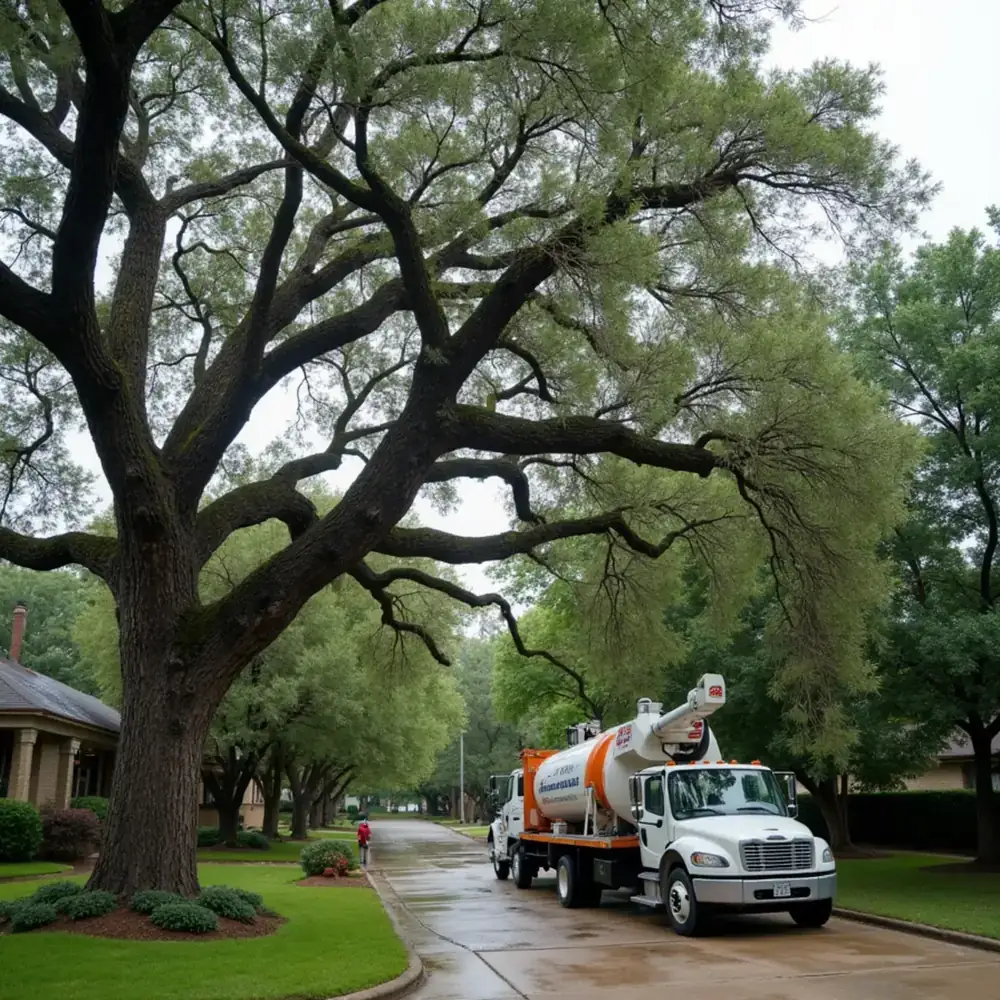
Cedar elms are everywhere in San Antonio for good reason: they're native, drought-tough, and shade a yard beautifully. But ask any local tree crew what they clean up most after a storm and cedar elm limbs will be near the top of the list. If you've got one, it pays to understand why they break and what actually reduces the risk.
Key Takeaways
- Cedar elms grow dense, twiggy canopies with tight, included-bark forks that attach weakly.
- Drought and past freezes leave hidden dead wood and old cracks throughout the crown.
- Crown thinning, deadwooding, and end-weight reduction dramatically cut failure risk.
- Never top a cedar elm — it triggers weak regrowth and more future breakage.
The Cedar Elm's Built-In Weakness
Cedar elms tend to grow dense, twiggy canopies with lots of small branches and frequent tight, V-shaped forks where limbs meet at narrow angles. Those narrow unions often trap bark inside them (called included bark), which makes the joint weak. Combine a heavy, dense canopy that catches wind like a sail with weak attachment points, and you get limbs that fail under storm loads.
Drought and Freeze Damage Add Up
Our climate makes it worse. Drought stress leaves dead and weakened wood scattered through the canopy, and hard freezes — like Winter Storm Uri — cracked countless cedar elm limbs that have been failing ever since. A cedar elm that looks fine can be carrying hidden dead wood and old cracks just waiting for the next 60-mph gust.
Where the Damage Lands
Because cedar elms are so common in older, value-minded neighborhoods, they tend to fail right over what you don't want them to: driveways, fences, and roofs. In areas like Kirby, where cedar elms and hackberries dominate the tree stock, storm-limb cleanup is one of the most common calls we get — often on trees that could have been thinned beforehand.
What Actually Reduces the Risk
You can't change a cedar elm's nature, but proper pruning dramatically cuts the odds of a failure:
- Crown thinning: Selectively reducing canopy density lets wind pass through instead of sailing the whole tree over.
- Deadwooding: Removing dead and weak limbs takes out the pieces most likely to drop first.
- Reducing end-weight: Shortening long, heavy limbs at proper laterals lowers the leverage on weak unions.
- Cabling weak forks: For a valued tree with an included-bark fork, a support cable can hold the union together.
What NOT to Do
Don't let anyone 'top' a cedar elm to control it. Topping triggers a flush of weak, fast regrowth attached to stubs — creating even more failure-prone limbs a few years down the road. Proper thinning and reduction cuts, made at the right places, are the only real solution. A thinning pass before storm season is cheap insurance compared to an emergency call afterward.
Related Services & Areas
Frequently Asked
Why do tree removal prices vary so much in San Antonio?
How do I know whether a damaged tree needs removal?
When is the best time to schedule preventive tree pruning in San Antonio?
The Bottom Line
A cedar elm's nature is to shed limbs, but a thinning-and-deadwood pass before storm season turns a reliable emergency into a non-event. Skip the topping; invest in proper cuts.
Need Help With Your Trees?
Get a free, no-pressure written estimate from a local, fully insured crew. Same-day and 24/7 emergency service available across San Antonio, Bexar County & the Texas Hill Country.