If you own live oaks in Central Texas, oak wilt is the disease to understand. It's lethal, it spreads, and by the time most people notice it, it's already moving through a neighborhood. The two main tools against it — propiconazole injection and trenching — work in completely different ways, and knowing which is which helps you spend your money where it counts.
Costs vary with the number and size of trees, site access, and how far the disease has spread, so treat the following as a framework rather than a fixed price list — we quote every oak-wilt job after seeing the site.
Key Takeaways
- Trenching severs shared roots to stop underground spread; injection protects individual high-value oaks.
- They're not either/or — a real plan often trenches to contain, then injects the oaks worth saving.
- Injection is protective and early-intervention, not a guaranteed cure.
- Commercial propiconazole application requires a Texas Department of Agriculture license — always confirm it.
First, How Oak Wilt Spreads
Oak wilt moves two ways. Above ground, sap-feeding beetles carry fungal spores from infected trees (especially red oaks, which form spore mats) to fresh wounds on healthy oaks. Below ground, live oaks growing near each other graft their roots together, and the fungus travels tree-to-tree through those connections — which is why one infected oak can start a spreading center that kills a whole cluster.
The two treatments each target one of those pathways.
Trenching: Stopping the Underground Spread
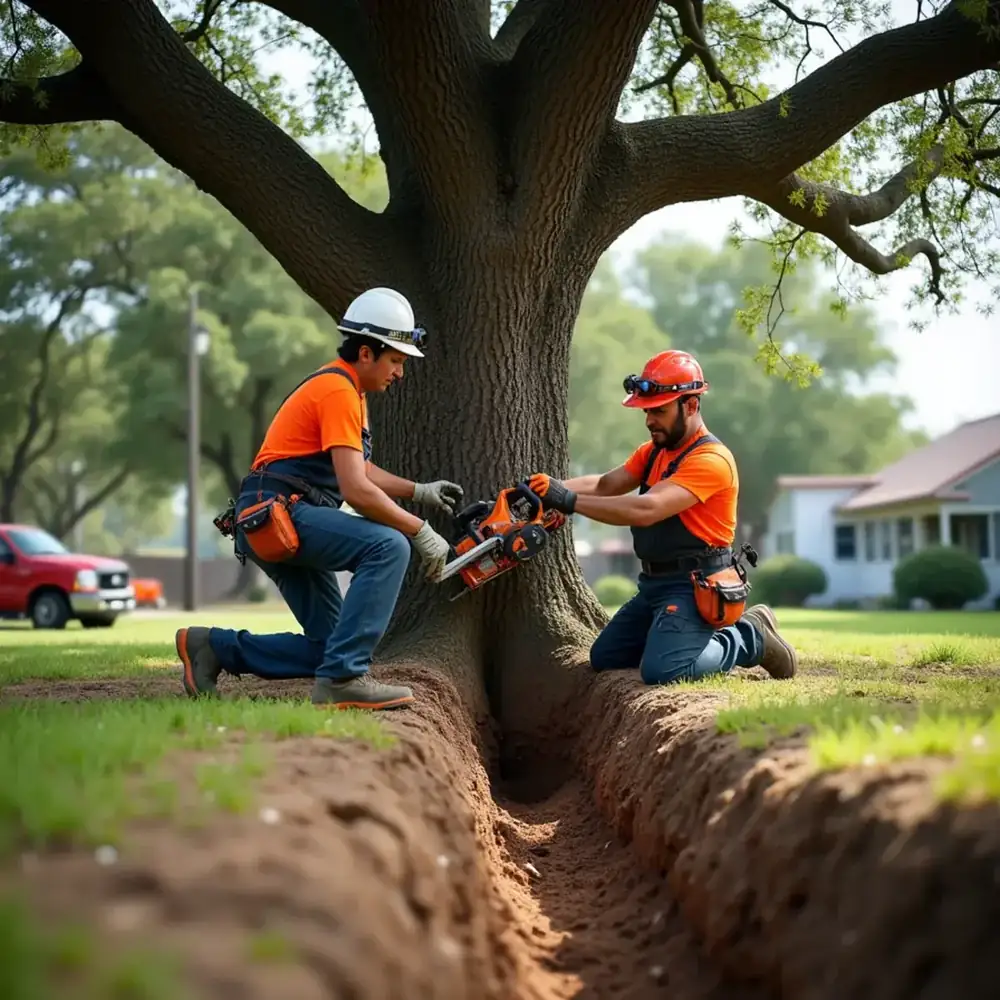
Trenching severs the root connections between infected and healthy oaks by cutting a deep trench — often 4 feet or more — between them. Done correctly, well outside the infection center, it creates a barrier the fungus can't cross underground. It's the primary tool for stopping an active spreading center from claiming more trees.
Cost depends on trench length and depth and on-site access for the equipment. It's an investment, but far cheaper than losing a stand of mature oaks — and in dense oak areas like Helotes, where root grafting is extensive, it's often the difference-maker.
Injection: Protecting Individual Trees
Propiconazole injection puts a fungicide directly into a tree's vascular system to protect high-value oaks that aren't yet infected, or to slow decline in oaks caught very early. It's priced per tree, generally by trunk diameter, so a few large oaks in a place like Stone Oak can add up — but for a signature tree you want to save, it's often worth it.
Two honest caveats: injection is a protective and early-intervention tool, not a guaranteed cure, and results depend on timing and the tree's condition. And in Texas, applying it commercially requires a Texas Department of Agriculture pesticide-applicator license — always confirm your provider holds one.
Injection vs. Trenching: Which Do You Need?
They're not either/or — a good plan often uses both. Trenching stops the spread through the roots; injection protects the valuable trees on the healthy side of the trench. If you have a confirmed center, trenching to contain it usually comes first, with injection to safeguard the oaks worth the most to you.
The Cheapest Defense Is Free: Prevention
Before you spend anything on treatment, prevention costs almost nothing and prevents a huge share of infections. Don't prune oaks between February 1 and July 1 when the beetles and fungus are most active, and paint every oak wound immediately, year-round. That single habit — plus prompt removal of infected red oaks — is the most cost-effective oak-wilt management there is.
Related Services & Areas
Frequently Asked
What is oak wilt and how does it affect Central Texas live oaks?
Can I prune a live oak between February 1 and July 1?
Does San Antonio require a Tree Maintenance License for tree contractors?
The Bottom Line
Budget for oak wilt as a system, not a single treatment: prevention, trenching to contain, and injection to protect. Caught early and managed correctly, a stand of live oaks can be saved.
Need Help With Your Trees?
Get a free, no-pressure written estimate from a local, fully insured crew. Same-day and 24/7 emergency service available across San Antonio, Bexar County & the Texas Hill Country.